 ultimate-guide
Deep Cleaning Services for Small Office Spaces
Table of Contents
- What Deep Cleaning Services for Small Office Spaces Actually Include
- Office Cleaning Checklist for Small Spaces
- How Often to Deep Clean an Office
- Office Cleaning Schedule and Service Frequency
- Office Cleaning Cost Factors and Transparent Pricing
- Why Eco-Friendly Products Matter for Small Office Deep Cleaning
- How to Choose and Hire the Right Office Cleaning Provider
- Preparation and Disruption Minimization
- Frequently Asked Questions
Last Updated: October 10, 2026
What Deep Cleaning Services for Small Office Spaces Actually Include
Deep cleaning services for small office spaces go far beyond the daily sweep and wipe, targeting edges, crevices, and high-touch zones that standard janitorial work leaves behind. Limited square footage means every surface matters, and overlooked corners accumulate dust and grime that regular cleaning misses.
High-touch surfaces and disinfection
High-touch surfaces, doorknobs, light switches, desk edges, keyboard trays, phone receivers, harbour bacteria and viruses far longer than most people realize (pubmed.ncbi.nlm.nih.gov). Deep cleaning services for small office spaces prioritize these zones with disinfection protocols.
Hard-to-reach areas and overlooked edges
Corners, ledges, and spaces behind equipment define the difference between a clean office and a truly deep-cleaned one. A 500-square-foot office has proportionally more corners and edges than larger spaces. Deep cleaning services address every neglected zone: door frame tops, cabinet handle interiors, desk undersides, and spaces between walls and filing cabinets.
Office Cleaning Checklist for Small Spaces
Use this room-by-room checklist to prepare your office, communicate expectations to your cleaning provider, and verify results after service.
Reception and Entry Areas
- Wipe down door frames, handles, push plates, light switches, and thermostat with disinfectant
- Clean glass doors and windows, including frames and sills
- Dust and sanitize reception desk surfaces, keyboard trays, and phone receivers
- Vacuum or mop flooring and baseboards, paying special attention to corners
- Empty and disinfect waste bins; replace liners
Workstations and Desk Areas
- Clear all desk surfaces before cleaning begins
- Dust monitor screens, keyboard frames, and desk edges
- Sanitize high-touch zones: armrests, desk edges, phone handsets, and drawer handles
- Vacuum under desks and chairs; move furniture to access floor underneath
- Wipe down filing cabinets, shelving, and storage unit tops
- Inspect for dust on cable management, power strips, and equipment vents
Washrooms and Common Areas
- Scrub toilet bowl, exterior, base, and tank with disinfectant
- Sanitize sink, faucet handles, and countertop; descale faucet aerators
- Clean mirror, frame, light fixtures, and exhaust vent cover
- Scrub grout lines and treat mold or mildew
- Disinfect soap dispensers, paper towel holders, and door handles
- Mop flooring, including corners and edges
- Wipe down walls for splashes or marks
Break Rooms and Kitchenettes
- Clean inside microwave, including turntable and interior walls
- Wipe down refrigerator exterior, handles, and interior shelves
- Sanitize countertops, backsplash, sink, and cabinet fronts; descale faucet
- Wipe down table and chairs, including crevices
- Mop flooring, including under appliances if movable
- Empty and disinfect waste and recycling bins
- Clean light fixtures and switches
Carpets and Hard Floors
- Vacuum all carpeted areas in multiple directions.
- For hard floors: sweep thoroughly, then mop with appropriate cleaner
- Pay special attention to corners, edges, and baseboards; inspect for scuffs requiring spot treatment
Air Quality and Ventilation
- Remove and clean air vent covers.
- Dust ceiling fans, light fixtures, and cabinet tops
- Wipe down window sills and frames; clean air return vents
Quality Verification Checklist After the deep clean is complete, inspect these markers to confirm thorough work:
- No visible dust on top of cabinets, light fixtures, or shelving
- Baseboards are clean and free of scuffs
- Corners and edges are dust-free
- High-touch surfaces (doorknobs, light switches, desk edges) are sanitized and streak-free
- Carpets are free of stains.
- Hard floors are free of residue or streaks.
- Washroom grout is clean.
- Air vents are clear and dust-free
- Air feels fresh.
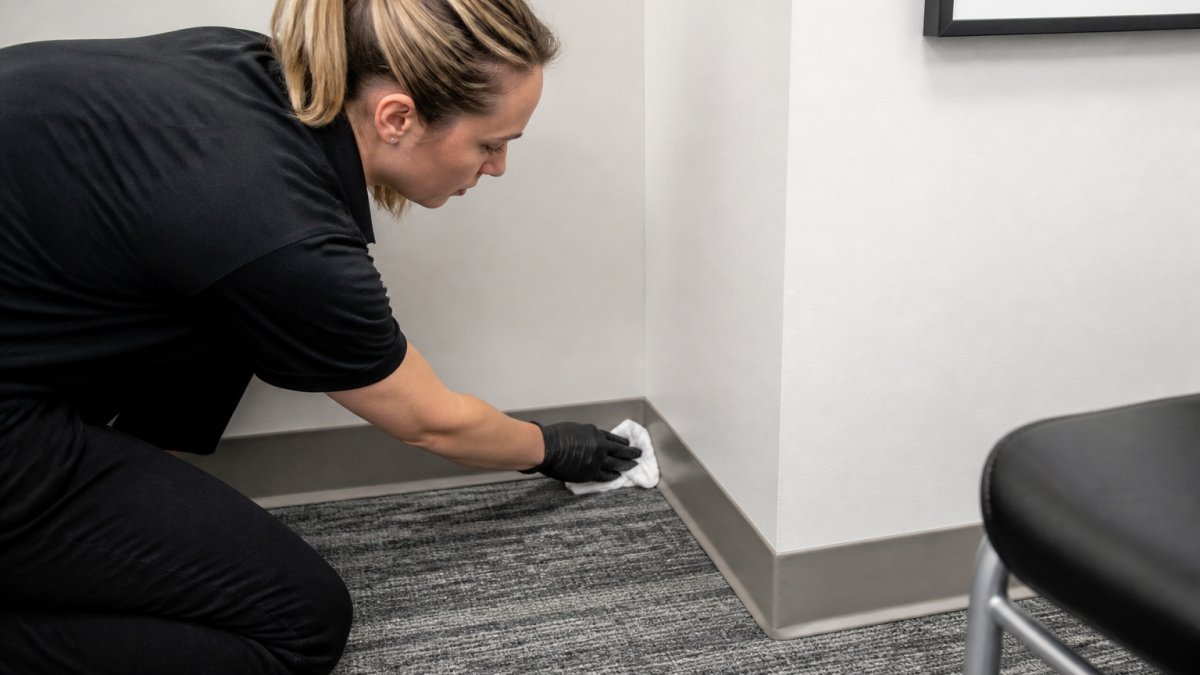
Provide this checklist to your cleaning provider before service begins. After service, walk through your office with the verification checklist and photograph any areas that don't meet expectations.
How Often to Deep Clean an Office
A small office typically needs deep cleaning every three to four months. High-traffic offices or those in healthcare, food service, or beauty may need monthly service. If you notice visible dust buildup, stale air quality, or carpet wear patterns, it's time for a deep clean.
Office Cleaning Schedule and Service Frequency
Building a sustainable office cleaning schedule balances cost, appearance, and health. Most small offices combine routine cleaning with periodic deep cleaning to maintain standards without overspending.
Routine cleaning versus deep cleaning
Routine cleaning (daily or weekly) includes vacuuming, dusting, emptying trash, and sanitizing high-touch areas. It prevents dirt accumulation but never reaches behind furniture, inside vents, or deep crevices.
Deep cleaning strips away buildup and disinfects thoroughly. Routine cleaning maintains those results between service dates, creating a sustainable system.
Flexible scheduling and after-hours service
Small offices operate on tight schedules where disruption costs money and productivity. After-hours deep cleaning services for small office spaces minimize interruption, with early morning, evening, or weekend service when the office is empty.
Office Cleaning Cost Factors and Transparent Pricing
Providers break down costs by square footage, task scope, and frequency rather than quoting a flat rate without inspection.
How Square Footage Affects Price
Square footage is the foundation of any cleaning estimate, but it alone doesn't determine final price.
Task-Specific Cost Breakdown
Understanding these task-specific costs helps you prioritize and budget:
- Carpet extraction: Hot-water extraction removes embedded soil and allergens, priced per square foot. Stain treatment adds additional cost.
- Hard-floor stripping and waxing: Removes buildup, restores finish, and creates a protective layer. Priced per square foot.
- Vent and ductwork cleaning: Improves air quality; often quoted as a fixed add-on or per-vent cost.
- Upholstery and fabric cleaning: Extends lifespan and removes allergen-triggering dust; priced per piece or by square footage.
- Grout and tile deep cleaning: Requires specialized brushes and cleaners; quoted per linear foot of grout or as a room add-on.
- Washroom deep cleaning: Thorough disinfection and mold treatment; sometimes quoted separately or as a per-fixture cost.
- Dusting and high-reach cleaning: Accessing ceiling fans, light fixtures, and cabinet tops; some providers include this, others charge an add-on fee.
Sample Cost Scenarios for Small Offices
These scenarios illustrate how different office conditions and task selections affect pricing. Actual costs vary by region and provider, but these examples show the relationship between scope and cost:
Scenario 1: 600-square-foot office, mostly hard flooring, minimal carpet
- Base deep clean (dusting, sanitizing, mopping): $400-$600
- Carpet extraction (200 sq. ft.): +$100-$150
- Hard-floor stripping and waxing (400 sq. ft.): +$150-$250
- Vent cleaning and filter replacement: +$75-$125
- Estimated total: $725-$1,125 for a one-time deep clean
Scenario 2: 800-square-foot office, mixed flooring, heavy carpet, upholstered furniture
- Base deep clean: $500-$700
- Carpet extraction (400 sq. ft.) with stain treatment: +$200-$300
- Hard-floor stripping and waxing (400 sq. ft.): +$150-$250
- Upholstery cleaning (4 office chairs): +$100-$160
- Grout and tile cleaning (washroom): +$75-$125
- Vent cleaning: +$75-$125
- Estimated total: $1,100-$1,660 for a one-time deep clean
Scenario 3: 500-square-foot office, basic deep clean without specialized tasks
- Base deep clean (dusting, sanitizing, mopping, vacuuming): $300-$450
- Estimated total: $300-$450 for a one-time deep clean
How Frequency Affects Per-Visit Cost
Recurring deep cleaning reduces per-visit cost. Calculate annual cost across frequencies to find best value.
Factors That Increase Cost
Certain conditions or requests will increase the quoted price:
- Heavy soiling or neglect: An office that hasn't been deep cleaned in over a year requires more labour to restore.
- Specialized equipment needs: Carpet extraction, floor stripping, or ductwork cleaning require equipment rental or specialized tools.
- Accessibility challenges: Offices on upper floors without service elevators, or spaces with narrow doorways that complicate equipment movement, may incur additional fees.
- Hazardous materials or biohazard cleanup: Mold remediation, bloodborne pathogen cleanup, or hoarding situations require specialized training and cost significantly more.
- After-hours or weekend service: Scheduling outside standard business hours typically adds 15-30% to the quoted price.
- Rush or emergency service: Requesting deep cleaning on short notice may incur a premium.
Factors That Decrease Cost
Conversely, certain conditions reduce the price:
- Regular maintenance: An office that receives routine cleaning between deep cleans requires less intensive labour.
- Minimal special tasks: An office with only hard flooring and no carpet, upholstery, or vent work costs less than one requiring multiple specialized services.
- Easy access: Ground-floor offices with wide doorways and ample space for equipment cost less to service.
- Flexible scheduling: Allowing the provider to schedule during their standard business hours (typically weekday mornings or afternoons) avoids after-hours premiums.
- Multi-office contracts: If you operate multiple small offices, bundling them into a single contract often yields volume discounts.
Red Flags in Pricing
Requesting and Comparing Estimates
When gathering quotes, provide each provider with identical information: square footage, floor plan, current condition, specific tasks, and preferred frequency.
Why Eco-Friendly Products Matter for Small Office Deep Cleaning
Eco-friendly cleaning products protect employee health and indoor air quality. In small offices with limited air circulation, chemical residue concentrates faster.
How to Choose and Hire the Right Office Cleaning Provider
Selecting a cleaning service that matches your office's needs requires clear evaluation criteria. Not every provider delivers the same quality, reliability, or attention to detail.
Quality assurance and measurable outcomes
Office cleaning providers stand behind their work with quality guarantees. Ask how they verify cleaning meets standards: checklists, before/after inspections, callbacks if unsatisfied?
Request references from other small office clients. Ask about consistency, attention to overlooked areas, and responsiveness to specific requests.
Reliability and consistent service
Small offices depend on cleaning services showing up on schedule and delivering consistent results.
Ask about the provider's track record with small office clients specifically.
Preparation and Disruption Minimization
Clear desks and floors so cleaners access every surface. Move personal items to secure locations and communicate the cleaning schedule to your team. After-hours scheduling minimizes workplace disruption entirely.
Deep cleaning services for small office spaces transform your workspace from functional to genuinely spotless. Pro Edge Cleaners brings eight years of industry experience and a commitment to eco-friendly products to every small office deep clean. Contact Pro Edge Cleaners today for a free estimate and discover how specialized attention to your specific space delivers measurable results.
Frequently Asked Questions
What is included in a deep cleaning service for a small office?
Deep cleaning services for small office spaces go beyond routine tidying. They include disinfecting high-touch surfaces like doorknobs and keyboards, dusting vents and baseboards, sanitizing washrooms, and cleaning overlooked edges and corners. The exact scope depends on your office layout.
How often should a small office be deep cleaned?
Frequency depends on office use and occupancy. Low-occupancy spaces can extend to quarterly deep cleaning. A professional provider will assess your office condition and recommend a schedule that maintains a healthy environment.
How much does deep cleaning cost for a small office?
Cost varies based on square footage, scope of work, current office condition, and service frequency. Pricing factors include disinfection depth, and whether you need one-time or recurring service. Request a free quote from a local provider who can assess your specific space.
Is professional deep cleaning worth it for a small office?
Yes, professional deep cleaning protects employee health, extends the life of carpets and furniture, and maintains a professional appearance for clients. It removes allergens, bacteria, and dust that routine cleaning misses. Eco-friendly products contribute to indoor air quality, making professional service a worthwhile investment.
What is the difference between regular office cleaning and deep cleaning?
Routine office cleaning handles daily tidying, vacuuming, and surface wiping. Deep cleaning addresses neglected areas: vent cleaning, upholstery sanitizing, and disinfection of high-touch surfaces. Deep cleaning removes embedded dirt, allergens, and bacteria that accumulate over time. Most small offices combine both: frequent routine cleaning with periodic deep cleaning for thorough maintenance.
How should I prepare my office for a deep cleaning service?
Clear desks and floors of personal items, and brief the cleaning team on any areas needing special attention. If scheduling after hours, ensure building access is arranged. Preparation minimizes disruption and allows the team to work efficiently.
What should I look for when hiring an office cleaning company?
Choose a provider with proven experience in small office spaces and a track record of reliability. Verify they use eco-friendly products safe for your employees. Ask about quality assurance processes and how they handle missed spots. Check that they offer flexible scheduling and can handle your specific needs. Request a free estimate and ask for references.