 Comparison
Are Eco-Friendly Cleaners Actually Effective?
Last Updated: November 2, 2026
Quick Summary
Yes, eco-friendly cleaners are effective for routine cleaning on most household soils, performing close to conventional products. The gap appears with disinfection and heavy grease removal, where conventional formulas still hold an edge. Green cleaners work, but not on every job.
- Plant-derived surfactants lift soil the same way synthetic ones do; formulation, concentration and dwell time decide results.
- Give green cleaners 3 to 5 minutes dwell time on fresh kitchen grease to close the performance gap.
- Baked-on oven grease and adhesive residue are jobs where conventional heavy-duty products still earn their place.
- Green, natural and eco are marketing words with no legal definition in Canada, so check the ingredient list instead.
- Concentrates are usually cheaper per use than ready-to-use sprays because you are not paying for water in the bottle.
Table of Contents
- Eco-Friendly Cleaners: What the Evidence Actually Shows
- Eco-Friendly vs. Traditional Cleaning Methods: Performance by Task and Surface
- Eco-Friendly Cleaning Products That Actually Work: A Comparison Table
- How to Choose Nontoxic Cleaning Products Without Paying for a Label
- Safe Cleaning Products for Asthma and Sensitive Households
- Cost Per Use, Concentration, and Water Hardness: The Hidden Variables
- DIY Cleaners and Their Limits: Vinegar, Baking Soda, and Hydrogen Peroxide
- Choosing a Cleaning Service That Uses Products You Can Trust
- Frequently Asked Questions
Eco-Friendly Cleaners: What the Evidence Actually Shows
Are eco friendly cleaners actually effective? Yes, for routine cleaning on most household soils, plant-based cleaners perform close to conventional products. The gap appears when you need disinfection or heavy grease removal. The honest answer sits in the middle: green cleaners work, but not on every job.
Here is the tension most buying guides skip. "Natural" describes where an ingredient comes from. "Effective" describes what it does on a surface. Those are two different questions, and a product can answer one without the other.
Why 'Natural' and 'Effective' Are Separate Questions
A cleaner works because of its surfactants, solvents, and pH, not because of its marketing. Plant-derived surfactants break surface tension and lift soil the same way synthetic ones do. What changes is the formulation around them: concentration, dwell time, and which soils the product was built to handle.
Eco-friendly cleaners are cleaning products formulated with plant-based or mineral ingredients that biodegrade readily and carry lower toxicity for people and aquatic life. That definition says nothing about performance. Judge a green cleaner the way you judge any cleaner: by the soil it removes and the surface it protects.
Eco-Friendly vs. Traditional Cleaning Methods: Performance by Task and Surface
On routine soils, the two categories land close. On grease and built-up soap scum, conventional alkaline formulas still hold an edge unless the green product is given more dwell time. On delicate surfaces, green cleaners often win because they skip harsh solvents that dull finishes. The difference is rarely the category, it is the formulation, the concentration, and whether the product was built for the soil in front of you.
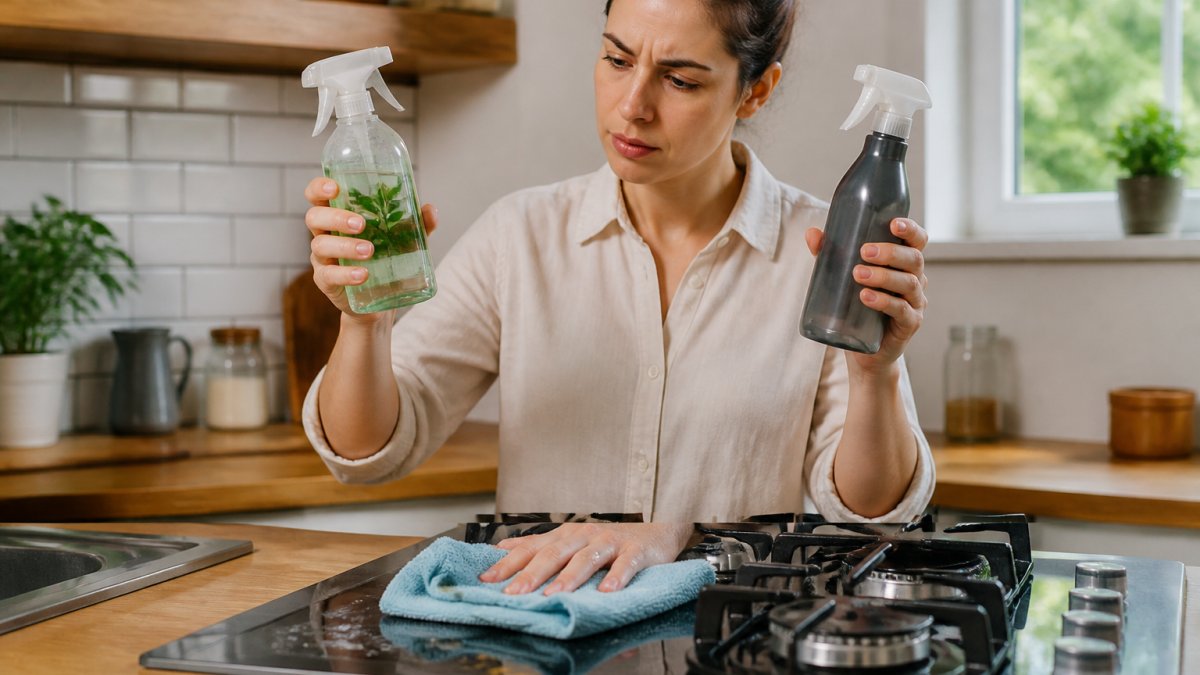
A Task-by-Task Effectiveness Matrix
The table below is a general guide to where plant-based cleaners tend to match conventional ones and where they need help. It is not a lab test.
| Task | Green cleaner performance | Conventional performance | What decides it | Practical adjustment |
|---|---|---|---|---|
| Dusting and light soil | Strong | Strong | Surfactant quality and cloth | None needed |
| Kitchen grease (fresh) | Moderate to strong | Strong | Alkalinity and solvent | 3-5 minutes dwell time |
| Baked-on oven grease | Weak to moderate | Strong | Strong solvent or high pH | Use conventional heavy-duty or a dedicated oven product |
| Soap scum | Moderate | Strong | Acid content | Add a mild acid (citric or acetic) or more dwell time |
| Glass and stainless | Strong | Strong | Streak-free formula | Use a dedicated glass formula |
| Daily bathroom touch-ups | Strong | Strong | Frequency of use | Clean more often with a mild product |
| Adhesive residue | Weak | Strong | Solvent strength | Use a dedicated adhesive remover |
| Pet accidents and odors | Moderate | Moderate | Enzyme action | Use an enzyme product and allow contact time |
Grease, Soap Scum, and Stains: Where Plant-Based Ingredients Keep Up
Plant-based degreasers generally handle fresh grease better when given contact time. Spraying and wiping in one motion is a common mistake. Baked-on oven grease is the exception where conventional heavy-duty products still earn their place. Soap scum responds to acid, not alkali; a green cleaner built around citric acid will outperform a general-purpose plant-based spray on shower glass, while a conventional acid bathroom cleaner will act faster. For stains on fabric, enzyme-based green detergents work well on protein and food stains but need longer contact time and warmer water than conventional stain removers.
Why the Gap Exists: Surfactants, Solvents, and pH
A cleaner works because of its surfactants, solvents, and pH, not because of its marketing. Plant-derived surfactants break surface tension and lift soil the same way synthetic ones do. What changes is the formulation around them: concentration, dwell time, and which soils the product was built to handle.
Eco-Friendly Cleaning Products That Actually Work: A Comparison Table
The products that earn repeat use share three traits: a clear ingredient list, a stated dilution or concentration, and a realistic use case on the label. Here is how the main categories compare for a household or small office.
| Product type | Best for | Watch out for | Concentration |
|---|---|---|---|
| Plant-based all-purpose spray | Counters, walls, light soil | Weak on grease | Ready to use |
| Citrus-based degreaser | Kitchen grease, stovetops | Can dull some plastics | Concentrate |
| Plant-derived dish soap | Hand dishwashing | Less foam in hard water | Concentrate |
| Enzyme laundry detergent | Stains, odors | Slow action in cold water | Concentrate |
| Hydrogen peroxide cleaner | Bathroom surfaces | Breaks down in light | Ready to use |
If you are setting this up for a workplace rather than a home, how to set up eco friendly cleaning for small offices walks through products, scheduling, and safe habits in one plan.
How to Choose Nontoxic Cleaning Products Without Paying for a Label
Start with the ingredient list, not the front label. "Green," "natural," and "eco" are marketing words with no legal definition in Canada. What you can verify is the ingredient disclosure, the hazard symbols, and whether the product makes a specific claim you can test.
- Ingredient list printed on the label or available online
- No added artificial fragrances if anyone in the home has asthma
- No chlorine bleach or ammonia unless the job genuinely requires it
- Dilution ratio stated clearly for concentrates
- A DIN if the product claims to disinfect
- Biodegradability stated for the formula, not just the packaging
Reading Ingredient Lists and Canadian Product Claims
Household chemical products are subject to hazard labelling requirements, and Health Canada's guidance on household chemical safety explains what labels must disclose. Look for the signal words and hazard symbols first, then the ingredients. A short, plain ingredient list is usually a better sign than a long list of certifications.
Safe Cleaning Products for Asthma and Sensitive Households
Fragrance is the trigger most often missed. Scented cleaning products can release irritants, and the scent itself can trigger symptoms in some people. Unscented, plant-based formulas reduce that exposure.
For a deeper ingredient-by-ingredient walkthrough, safe cleaning products for asthma covers which ingredients to avoid and how to clean without irritating lungs. Ventilation matters as much as product choice: open a window, run a fan, and clean when the sensitive person is out of the room.
Cost Per Use, Concentration, and Water Hardness: The Hidden Variables
Concentrates are usually cheaper per use than ready-to-use sprays, because you are paying for water in the bottle. A concentrate diluted to the label ratio can stretch across many more cleaning sessions than a pre-mixed spray at the same shelf price. Do the math on cost per use, not sticker price.
Water hardness changes results too. In hard water, soaps and detergents foam less and leave more residue, so you may need slightly more product or a water softener to get the same clean. If you are weighing professional cleaning against doing it yourself, transparent pricing for sparkling clean spaces shows how job size and frequency shape a quote.
DIY Cleaners and Their Limits: Vinegar, Baking Soda, and Hydrogen Peroxide
None of these carry a disinfectant claim, and mixing vinegar with bleach produces chlorine gas, so never combine them. DIY cleaners are cheap and effective for light work, but they are not a substitute for a proper disinfectant in a rental turnover.
Choosing a Cleaning Service That Uses Products You Can Trust
Ask any cleaning service three questions: which products they use, whether those products are unscented, and whether they hold a disinfectant claim where it matters. A service that cannot answer specifically is guessing. At Pro Edge Cleaners, we use environmentally safe cleaning products, and the owner personally oversees our work.
If you would rather hand the work to a team that already knows the difference between cleaning and disinfecting, embrace a greener clean with a thorough clean and no harsh chemical residue. When you are ready to talk through your space, contact Pro Edge Cleaners for a free quote.
Frequently Asked Questions
Are eco-friendly cleaners as effective as conventional cleaners?
Eco-friendly cleaners are generally suited to routine cleaning, while heavier grease, soap scum, and disinfecting tasks may call for a different product. For most everyday cleaning in homes and small offices, a well-formulated eco-friendly cleaner is enough, but keep a targeted disinfectant for high-touch and illness situations.
Do natural cleaning products kill bacteria and viruses?
Most natural cleaning products are not disinfectants. If you need to kill bacteria and viruses, check the product label for a disinfectant claim and follow the label's contact time. Eco-friendly cleaners are best treated as routine cleaners, not as replacements for a registered disinfectant.
Are eco-friendly cleaning products safer for people with asthma?
Fragrance-free, dye-free, and low-VOC eco-friendly cleaners generally reduce exposure to irritants that can trigger asthma symptoms. Some cleaning fumes can irritate the airways, so choosing gentler products and ventilating while cleaning is sensible. However, 'natural' does not automatically mean asthma-safe: some plant-derived essential oils are volatile and can irritate airways. Look for fragrance-free formulas and ventilate while cleaning.
How can I tell whether a cleaner is genuinely environmentally friendly?
Check the ingredient list for transparency, treat vague terms like 'green' or 'natural' as marketing rather than proof, and check the ingredient list and label claims. Also compare concentration: a concentrated product that you dilute reduces packaging and cost per use, which is a more reliable sign of environmental intent than a leaf icon on the bottle.
The real test of a green cleaner is not the label, it is whether it removes the soil in front of you without leaving a residue or an irritant behind. That takes the right product, the right dwell time, and someone who knows which surface needs which formula. Get started with Pro Edge Cleaners and a plant-based clean that protects your health, your surfaces, and the people who use the space.