 listicle
Molly Maid Alternatives Worth Considering
Table of Contents
- Why Homeowners Look for a Molly Maid Alternative
- Molly Maid vs Local Cleaning Services: What Actually Differs
- How to Run a Cleaning Service Quote Comparison
- Step 1: Fix the home profile before you request a single quote
- Step 2: Force every quote into the same four-line format
- Step 3: Normalize to a monthly cost, not a per-visit cost
- Step 4: Score scope, not just price
- Step 5: Verify the policy terms that decide disputes
- What a written estimate should include
- Recurring House Cleaning Services and Scheduling Flexibility
- Eco-Friendly House Cleaning Products: Do They Actually Work?
- Insurance, Bonding, and Damage Policies to Verify
- Pro Edge Cleaners as a Molly Maid Alternative
- Conclusion
- Frequently Asked Questions
Last Updated: October 18, 2026
Why Homeowners Look for a Molly Maid Alternative
Searching for molly maid alternatives usually starts with a specific frustration: a quote without a breakdown, a rotating crew, or a corner that never quite got clean.
The short version: when weighing molly maid alternatives, any provider offering residential house cleaning outside the franchise model counts, typically a locally owned company with direct owner oversight.
Molly Maid vs Local Cleaning Services: What Actually Differs
The core difference is who answers for the work. In a franchise, an office schedules crews and a corporate playbook sets the checklist.
That shapes pricing, crew consistency, rescheduling, and complaint resolution.
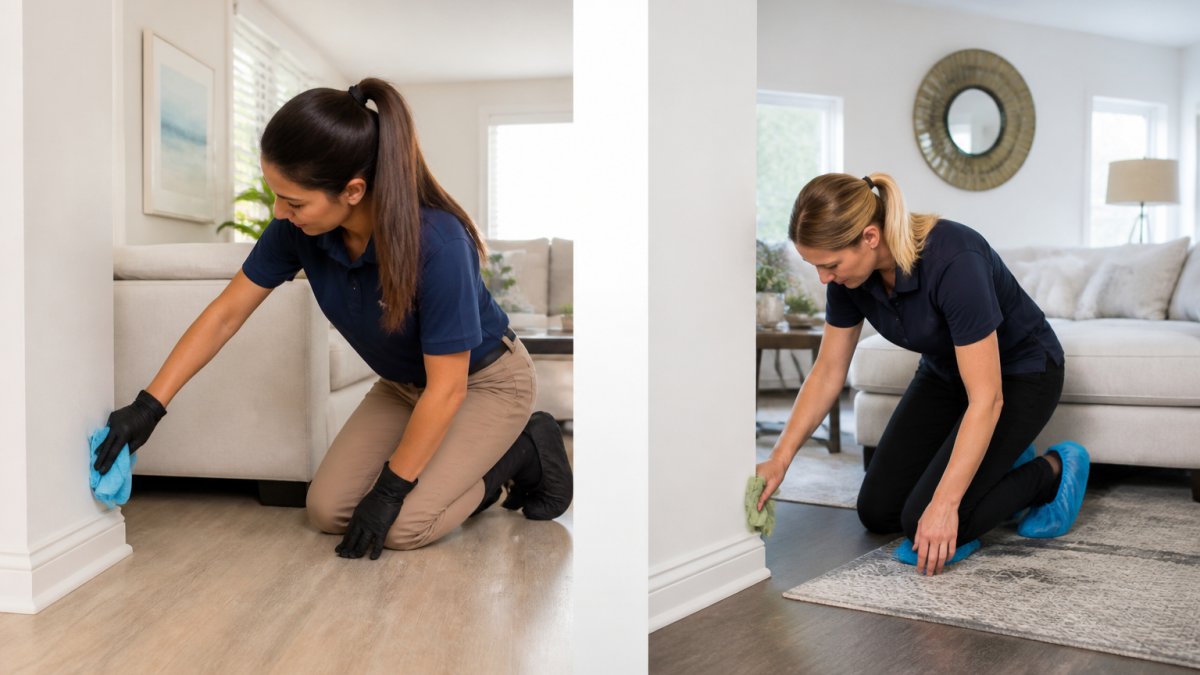
Franchise Standards vs Owner-Led Oversight
Franchise standards give you a documented, repeatable checklist, useful for predictable scope. The trade-off: the person scheduling your clean rarely sees your home.
With owner-led oversight, the owner is accountable to a local reputation, so quality issues get addressed directly rather than escalated through a call center. Ask any provider: who inspects the work, and when?
How to Run a Cleaning Service Quote Comparison
A cleaning service quote comparison is a structured side-by-side review of written estimates from at least three providers, scored on scope, price, and policy terms rather than price alone. Most homeowners compare the bottom-line number and stop there, the mistake that leads to callbacks, since two similar quotes can represent completely different scope.
The method below normalizes every estimate to the same home, frequency, and add-on list before you score anything.
Step 1: Fix the home profile before you request a single quote
Write down one home profile and send identical details to every provider:
- Bedrooms: 3
- Bathrooms: 2.5
- Approximate square footage: 1,800
Change any variable and the quotes are not comparable. Send the profile by email so you have a record of what each provider was asked to price.
Step 2: Force every quote into the same four-line format
Ask each provider to return the estimate in four lines, not a paragraph:
- Base price per visit for the stated frequency.
- One-time or first-visit price, if different from the recurring rate.
- Add-on prices, itemized per task (oven, fridge, windows, laundry, garage, basement).
- Fees and terms: cancellation fee, lockout fee, late-payment fee, holiday surcharge, and whether taxes are included.
A provider that will not break the quote into those four lines is telling you how they will handle a disputed invoice.
Step 3: Normalize to a monthly cost, not a per-visit cost
Per-visit pricing hides frequency games: a biweekly plan at a lower per-visit rate can cost more per month than a weekly plan at a higher rate.
Worked example using the 3-bedroom, 2.5-bath, 1,800 sq ft profile above, biweekly (roughly 2.17 visits per month):
| Line item | Provider A | Provider B | Provider C |
|---|---|---|---|
| Base price per visit (biweekly) | $145 | $165 | $130 |
| First-visit deep clean | $260 | $165 (same as recurring) | $310 |
| Oven add-on | $25 | included | $35 |
| Fridge add-on | $25 | included | $35 |
| Interior windows add-on | $40 | $30 | not offered |
| Cancellation fee | $50 under 48 hrs | none stated | $75 under 24 hrs |
| Taxes included? | no, plus tax | yes | no, plus tax |
| Normalized monthly (base only) | ~$315 | ~$358 | ~$282 |
| Normalized monthly (base + add-ons) | ~$510 | ~$388 | ~$387 |
Provider C has the lowest base rate but the highest all-in monthly cost once add-ons are priced. Provider B looks expensive per visit but includes add-ons and states no cancellation fee.
Step 4: Score scope, not just price
Build a checklist of tasks and mark included, extra, or not offered for each provider. A standard clean typically covers dusting reachable surfaces, vacuuming and mopping floors, bathroom sanitizing, kitchen counters and exterior appliance surfaces, and trash. Deep cleans add baseboards, door frames, inside empty cabinets, vent covers, and buildup scrubbing. Move-in and move-out cleans add inside appliances, inside closets, and wall spot-cleaning.
Step 5: Verify the policy terms that decide disputes
Before you score, confirm in writing:
- Liability insurance and a certificate you can see.
- Bonding, and what the bond actually covers.
- Background-check policy for cleaners entering the home.
A quote silent on any of those is incomplete, score it as such rather than guessing.
What a written estimate should include
A written estimate should state the checklist task by task, the pricing model, visit frequency, add-on prices, fee schedule, and cancellation and rescheduling terms. If any item is missing, it is not ready to compare.
Check whether the estimate separates standard cleaning from deep, move-in, and move-out cleaning. Those are different jobs with different scope, and bundling them into one vague number is how homeowners pay for work that was never specified.
Recurring House Cleaning Services and Scheduling Flexibility
Recurring house cleaning services are scheduled visits at a set frequency, weekly, biweekly, or monthly, priced lower per visit than a one-time clean.
Scheduling flexibility is where local providers usually pull ahead. Ask these questions before signing anything:
- How much notice do you need to reschedule a visit?
- Is there a cancellation fee, and how is it calculated?
- Can I add deep cleaning tasks to a recurring visit?
For landlords and short-term rental hosts, the fixed-date question is critical. Turnover cleaning has no slack, so a provider that cannot commit to a date in writing is a risk.
Eco-Friendly House Cleaning Products: Do They Actually Work?
Eco-friendly house cleaning products are formulated to reduce exposure to harsh chemicals while still removing soil and residue. Effectiveness depends on the product and dwell time, not the label alone.
Eco-friendly cleaning is less about the bottle than technique. Proper dwell time, microfiber cloths, and thorough edge and corner work often matter more than formulation.
Insurance, Bonding, and Damage Policies to Verify
Insurance, bonding, and damage policies determine what happens if something breaks, goes missing, or gets damaged during a clean. Verify all three in writing before the first visit, after an incident is too late.
The useful version explains what each covers, what it does not, and how to verify it without taking a provider's word for it.
Liability insurance: what the certificate actually tells you
Liability insurance covers damage the cleaning business causes to your property while working, a broken fixture, a scratched floor, a stained surface from a spilled product. Ask for a certificate of insurance and check four things:
- The named insured matches the business name on your quote, not a different entity.
- The policy is current, with an expiry date in the future.
- The coverage type is commercial general liability, not a homeowner or auto policy.
A certificate is a snapshot, not a guarantee. It shows coverage existed on the date issued. If the policy is close to expiry, ask for an updated certificate before the first visit. If the provider is a sole proprietor working alone, ask directly whether they carry commercial liability coverage at all, many do not, and that is a material risk you should price into the decision.
Bonding: what it covers and what it does not
Bonding is often confused with insurance. A bond protects against employee dishonesty, typically theft by a worker, and is usually arranged through a surety. Liability insurance generally does not cover intentional theft by an employee, which is why the two are asked for together.
Ask the provider two questions: is the business bonded, and does the bond extend to every cleaner who will enter your home, including subcontractors?
Background checks: the policy, not the promise
"We screen our cleaners" is not a policy. A verifiable policy states what is checked (criminal record check, references, employment history), how often it is refreshed, and whether it applies to subcontractors. Ask when the last check was completed for the crew assigned to your home. A provider that cannot answer at the crew level is relying on a general statement, not a process.
The damage policy: how a claim actually runs
A written damage policy should answer five questions:
- How do I report damage, and to whom, and by when?
- Who assesses the damage and decides whether it is covered?
- Is there a repair-or-replace standard, and who chooses the vendor?
- What is the timeline from report to resolution?
- What happens if we disagree on the cause or the amount?
A common pattern is a 24- to 48-hour reporting window, an owner or manager assessment, and a repair by a vendor of the provider's choosing. That is workable if it is written down. It is a problem if it is improvised after the fact.
Satisfaction guarantee: read the remedy, not the slogan
A satisfaction guarantee is only as good as its remedy. Look for the specific mechanism: a re-clean within a stated window (commonly 24 to 72 hours), a credit, or a refund, and the conditions that void it. A guarantee that requires you to report the issue before the crew leaves the driveway is narrower than one that allows a next-day report.
A verification checklist you can run in one call
- Request the certificate of insurance by email and confirm the named insured and expiry date.
- Ask whether the business is bonded and whether the bond covers subcontractors.
- Ask what the background-check policy covers and when the assigned crew was last checked.
A provider that hesitates on any of these is telling you something. Reliability and professional standards start with paperwork, not with a friendly phone manner.
Pro Edge Cleaners as a Molly Maid Alternative
Pro Edge Cleaners is a locally owned and operated cleaning service built around the details that franchise checklists tend to skip: the edges, the corners, and the spots behind the fixtures.
What that means for you in practice:
- Detail-focused cleaning: we specialize in the overlooked edges and corners, not just the open floor space.
- Environmentally safe products: we use eco-friendly cleaning products, which matters for households managing asthma or chemical sensitivity.
- Consistent, dependable service: the same standard applies to every visit, residential or commercial.
We also take on smaller commercial spaces, including offices with a handful of staff, and we work with landlords and short-term rental hosts who need turnover cleaning on a fixed schedule.
Conclusion
Comparing cleaning providers is tedious, and most homeowners do it once, badly, under time pressure. The fix is to slow down for one hour and run the quote comparison properly: identical home details, written scope, verified insurance, and a confirmed cancellation policy.
If you want a provider that treats edges and corners as part of the job rather than an upgrade, Pro Edge Cleaners is built for exactly that.
Frequently Asked Questions
What are the best alternatives to Molly Maid for house cleaning?
The best fit depends on your priorities. Locally owned operators often provide owner oversight, flexible scheduling, and eco-friendly products, while national franchises offer standardized checklists and established booking systems. Compare at least three providers on written estimates, insurance and bonding, staff screening, and what each visit actually covers. Ask whether the same crew returns each time, how cancellations are handled, and whether deep cleaning or move-out cleaning is included or priced separately.
How do local cleaning services compare with Molly Maid on price?
Franchise pricing usually bundles overhead like branding, call centers, and territory fees, which can push quotes higher than a comparable local operator. Local services often quote based on home size, number of bedrooms and bathrooms, and cleaning frequency, with flat-rate pricing for recurring visits. Always request a written estimate from both types of provider and compare line by line: what tasks are included, what costs extra, and whether products and supplies are billed separately.
How can I compare cleaning service quotes fairly?
Use the same inputs for every quote: home size, bedroom and bathroom count, cleaning frequency, and any add-ons like inside-oven or fridge cleaning. Ask each provider for a written estimate that lists tasks included and excluded, the hourly rate or flat rate, cancellation and rescheduling terms, and whether the same cleaners return. A cleaning service quote comparison only works when the scope matches, so confirm whether deep cleaning, move-in cleaning, or move-out cleaning is priced separately.
Do cleaning companies offer both one-time and recurring house cleaning?
Most do, but terms differ. Recurring house cleaning services typically come at a lower per-visit rate because the home stays maintained, while one-time or deep cleaning costs more per visit due to the extra labor. Ask about minimum commitments, whether you can pause or reschedule without penalty, and how much notice is required. If you host short-term rentals, confirm the provider can handle multiple turnovers in one day and whether you get consistent cleaners who know your standards.
What should I ask before hiring a house cleaning service?
Ask about insurance and bonding, background checks for cleaners, and the provider's damage policy if something breaks. Confirm the cleaning checklist covers edges and corners, not just open surfaces, and whether eco-friendly house cleaning products are standard or an upgrade. Get the cancellation and satisfaction guarantee in writing, ask who supervises the crew, and request references from clients with similar homes. A phone consultation plus a written estimate usually reveals how organized and reliable a provider is.